❤️

Buon viaggio!

Qui ripasserai le strutture di base del livello Principianti.

Gli elementi linguistici che troverai sono:

Molti studenti hanno ancora problemi con l'uso dei verbi italiani. Capiamo che le coniugazioni dei verbi possano non essere facili. Tuttavia, sono molto importanti.

Per imparare l'uso dei verbi, studia le terminazioni (desinenze) corrette e continua a praticare con gli esercizi.

Many students still have problems with the use of Italian verbs. We understand that verb conjugations may not be easy. However, they are very important.

In order to learn the use of verbs, study the correct endings and keep on practicing with the exercises.

Ricorda che i verbi italiani hanno tre diverse terminazioni all'infinito: ARE, ERE, IRE (ballARE, ridERE, dormIRE). Per coniugare un verbo bisogna togliere le terminazioni (desinenze) dell'infinito e sostituirle con altre desinenze appropriate.

Remember that Italian verbs have three different endings for the infinitive: "ARE", "ERE", "IRE" (ballARE, ridERE, dormIRE). To conjugate a verb you replace the ending of the infinitive with other appropriate endings.

Per esempio, il presente indicativo del verbo BALL-ARE:

io ball-o
tu ball-i
lui/lei ball-a

noi ball-iamo
voi ball-ate
loro ball-ano

Parlando di Pinocchio, (lui), sostituisci l'infinito ARE con "A", la terza desinenza del presente: "Pinocchio ballA. Geppetto non ballA, Geppetto lavorA".

For example, the present indicative of the verb BALL-ARE (to dance):

io ball-o
tu ball-i
lui/lei ball-a

noi ball-iamo
voi ball-ate
loro ball-ano

Talking about Pinocchio, (lui), you substitute the infinitive ARE with "A", the third ending of the present: "Pinocchio ballA. Geppetto non ballA, Geppetto lavorA".

Io ball O sempre. Tu ball I ?

"Io ball O sempre. Tu ball I ?" (I always dance. Do you dance?)

Per formare il passato prossimo devi usare il verbo avere o essere con il participio passato del verbo.

To form the " passato prossimo ", you have to use the verb "avere" (to have) or "essere" (to be) with the past participle of the verb.

Per esempio, per formare il passato prossimo di BALLARE usi il verbo avere e sostituisci la desinenza dell'infinito "ARE" con la desinenza del participio passato "ATO": Pinocchio HA ballATO. Io non HO ballATO.

For example, to form the "passato prossimo" of BALLARE (to dance) you use the verb "avere" and you substitute the infinitive "ARE" with "ATO", the ending of the Past Participle: "Pinocchio HA ball ATO . Io non HO ball ATO" (Pinocchio has danced. I have not danced.)

Per formare il passato prossimo di USCIRE (verbo di "movimento") usiamo "essere" e cambiamo l'infinito "IRE" in "ITO": "Lui È uscITO. Io non SONO uscITO".

To form the "passato prossimo" of USCIRE (to go out - verb of "mouvement") we use "essere" and change the infinitive "IRE" with "ITO" : "Lui È usc ITO . Io non SONO usc ITO".

Tu sei uscito ieri? Hai ballato?

"Tu sei uscito ieri? Hai ballato?" (Did you go out yesterday? Have you danced?)

Fai un ripasso dei verbi

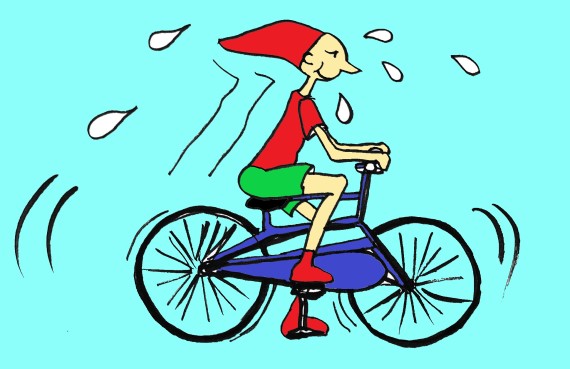
Pinocchio in bicicletta

Con un po' di sforzo in più, approfondisci l'argomento:

Presente indicativo Passato prossimo Participio passato

Struttura base della frase es. 2 es. 5 es. 6 ed es. 9

La struttura basica di una frase italiana è molto semplice:

verbo + articolo & nome + aggettivo

Leggo un libro interessante.

The basic structure of an Italian sentence is very simple:

verb + article & noun + adjective

"Leggo un libro interessante." (I read an interesting book).

Naturalmente possono esserci molte variazioni alla frase precedente. A volte è necessario rendere la frase più chiara e includere il soggetto:

"Io leggo un libro interessante."

Il libro è interessante.

Of course, you may have many variations to the above structure. Sometimes you need to make the sentence clearer and include the subject:

"Io leggo un libro interessante." (I read an interesting book).

"Il libro è interessante." (The book is interesting).

A volte, con alcuni verbi o certe espressioni è necessario aggiungere una preposizione:

Il libro parla di storia.

Sometimes, with certain verbs or certain expressions you need to add a preposition:

"Il libro parla di storia." (The book talks about history).

A volte, per rendere la comunicazione più forte, si può aggiungere un avverbio:

Il libro è veramente interessante.

Sometimes, to make your communication stronger, you can add an adverb:

"Il libro è veramente interessante." (The book is really interesting).

Uso della descrizione esercizio 11 ed esercizio 12

Boccioni
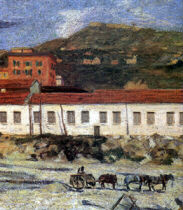
Umberto Boccioni La fabbrica Foltzer (1908-1909)
Umberto Boccioni è un famoso pittore italiano del XX secolo. È conosciuto anche per la sua appartenenza al Futurismo un movimento artistico a cui piacevano la modernità, i motori, la velocità e la tecnologia.
Umberto Boccioni is a famous Italian painter of the 20th century. He is also renowned for being part of the Futurism an art movement who liked modernism, motors, speed and technology.

Il dipinto precedente, "La fabbrica Foltzer", è un dipinto dei tempi iniziali che potremmo chiamare descrittivo . Vediamo una fabbrica bianca, i cavalli, la collina nello sfondo... Con una "semplice descrizione" Boccioni ci da un'idea di com'era la fabbrica Foltzer.

The above painting, "La fabbrica Foltzer", is an early painting that we might call descriptive . We see a white factory, the horses, the hill in the background... With a "simple description" Boccioni gave us an idea of what the Foltzer factory was like.

Nello stesso modo, con "semplici descrizioni", gli studenti elementari possono dire molte cose.
Ad esempio descrivendo il quadro di Boccioni:

C'è una casa bianca.

C'è una casa rossa.

Ci sono 4 cavalli.

Il quadro è sereno e interessante. Il quadro mi piace.

Il quadro è disturbante, non è sereno né interessante. Il quadro non mi piace.

...

In the same way, with "simple descriptions", beginner students can say many things.

For example, describing Boccioni's painting:

C'è una casa bianca. (There is a white house.)

C'è una casa rossa. (There is a red house.)

Ci sono 4 cavalli. (There are 4 horses.)

Il quadro è sereno e interessante. Il quadro mi piace. (The picture is serene and interesting. I like the painting.)

Il quadro è disturbante, non è sereno né interessante. Il quadro non mi piace. (The picture is disturbing, it is not serene nor interesting. I don't like the painting.)

...

Mettiti alla prova e non avere paura di parlare in italiano! Usa frasi brevi e semplici per esprimere le tue opinioni e parlare di argomenti familiari.
Challenge yourself and don't be afraid to speak Italian! Use short and simple sentences to express your opinions and talk about familiar topics.

Nei dialoghi precedenti fra Pinocchio e il Grillo forse hai notato questa espressione:

"È importante avere dei buoni amici"

In the previous dialogues between Pinocchio and Grillo, you might have noticed the expression:

"È importante avere dei buoni amici" (it is important to have some good friends).

"Dei" ("di" unito all'articolo determinativo "i") è un partitivo.

"Dei" ("di" combined with the definite article "i") is a partitive.

Il partitivo indica una parte di qualcosa (come: un po' di, alcuni, qualche...)
A partitive indicates a part of a whole (like: some, any, a few, part of, a little bit of)

Il partitivo si forma con:

  • "di" + articolo determinativo

oppure

  • qualche

oppure

  • alcuni

oppure

  • un po' di

The partitive is formed with:

  • "di" + articolo determinativo

or

  • qualche

or

  • alcuni

or

  • un po' di

Ho dei libri.
Hai dei libri?

"Ho dei libri." (I have some books).
"Hai dei libri?" (Do you have any book?).

Qualche è invariabile e si usa con nomi al singolare:
Ho qualche libr o .

" Qualche " is invariable and is used with singular nouns:
"Ho qualche libr o ." (I have some books, a few books).

Alcuni/alcune sono usati con nomi al plurale:
Ho alcuni libr i .
Ho alcune penn e .
Fra i partitivi quest'ultimo è il più formale.

" Alcuni/alcune " are used with nouns in the plural form:
"Ho alcuni libr i ." (I have some books, a few books).
"Ho alcune penn e ."(I have some pens, a few pens).
Among the partitives this is the most formal.

Un po' di si usa per indicare "un poco di" qualcosa:
Ho un po' di fame.
Vorrei un po' d'acqua.

"Un po' di" is used to indicate "a bit of" something:
"Ho un po' di fame" (I'm a little hungry)
"Vorrei un po' d'acqua" (I'd like a little bit of water)

Pinocchio in bicicletta

With a little extra effort, delve deeper into the topic:

Partitivi

Sviluppo dell'ascolto

Molti studenti hanno ancora problemi con il capire un audio o la pronuncia italiana.

In ogni lezione ci sono molti modi per sviluppare il tuo ascolto: attraverso il Dialogo, il Bocconcino Culturale, gli esercizi e le attività.

Ascoltare un audio mentre si legge la trascrizione è un ottimo modo per praticare.

Prova ora con gli audio seguenti.

Many students still have problems to understand an Italian audio or pronunciation.

In each lesson there are many ways to develop your listening skills: through the Dialogue, the Cultural Tidbit, the exercises and the activities. Listening to an audio while reading the transcript is a great way to practice.

Try now with the following audios.

CHE TEMPO FA?

OGGI FA BEL TEMPO

tempo bello

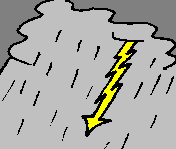
OGGI FA BRUTTO TEMPO

fulmini

OGGI PIOVE

pioggia

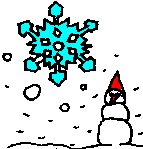
OGGI NEVICA

neve

OGGI C'È IL SOLE

tempo bello

I materiali autentici (film, canzoni, pubblicità...) possono sembrare più difficili da capire.

Non avere paura di ascoltare materiali autentici. Se non capisci tutto non è un problema. Cerca di capire il significato generale dell'audio/testo.

Ascolta di seguito l'audio di una pubblicità, mentre leggi un estratto della trascrizione.

Usa il dizionario online se necessario. Per aiutarti abbiamo tradotto i punti più difficili.

Authentic materials (films, songs, advertisements ...) may seem more difficult to understand.

Do not be afraid of listening to authentic materials. If you do not understand everything, it is not a problem. Try to understand the general meaning of the audio/text.

Listen to an advertisement below, while you read an excerpt from the transcript.

Use the online dictionary if you need. In order to help you, we have translated the most difficult parts.

Ah, l'estate.. ogni anno l'aspetti per 9 lunghi mesi (you wait for it for 9 long months). Aspetti di indossare i tuoi vestitini leggeri (you wait to wear your cute light dresses). Aspetti le granite al limone, i piedi nella sabbia, tutte le sere. È l'estate, la stagione in cui (in which) ti senti (you feel) veramente vivo. E in cui (in which) inizi a pensare e poi a puzzare (to stink), quei vestitini leggeri ti si appiccicano addosso (those cute light dresses stick on you), arrivano le zanzare, zzz, non riesci a dormire (you can't sleep), vorresti (you would like) fare altro ma fa caldo...

Pronuncia

Ascolta la parola/frase, clicca sul microfono per registrarti e cerca di raggiungere il punteggio più alto!