❤️

Cosa preferisci?

Qui imparerai a esprimere preferenze, fare domande e rispondere negativamente.

Here you will learn to express preferences, ask questions and answer in a negative way.

Gli elementi linguistici che troverai sono:

The linguistic elements you will find are:

Verbi regolari es. 2 es. 4 es. 5 ed es. 6

"BALLARE", "RIDERE" e "DORMIRE" sono verbi all'infinito. L'infinito è la forma del verbo che si trova nel vocabolario.

"BALLARE", "RIDERE" and "DORMIRE" are verbs in the infinitive form. The infinitive is the form of the verb presented in the dictionary.

Sicuramente, avrai già notato che i verbi italiani hanno tre diverse terminazioni: ARE, ERE, IRE.

  1. I verbi che terminano in "are" appartengono alla prima classe.
  2. I verbi che terminano in "ere" appartengono alla seconda classe.
  3. I verbi che terminano in "ire" appartengono alla terza classe.

I'm sure you have noticed that Italian verbs have three different endings: "ARE", "ERE", "IRE".

  1. Verbs ending with "are" belong to the first class.
  2. Verbs ending with "ere" belong to the second class.
  3. Verbs ending with "ire" belong to the third class.

I verbi italiani sono formati da due parti: la radice (invariabile) e la desinenza (variabile). In "ballare, ridere, dormire", "are", "ere" e "ire" sono desinenze e BALL-, RID- e DORM- sono radici.

Italian verbs consist of two parts: stem (invariable) and ending (variable). In "ballare, ridere, dormire", "are", "ere" and "ire" are endings and BALL-, RID- and DORM- are stems.

In una frase italiana, la coniugazione del verbo indica il soggetto (chi fa o riceve un'azione), e il tempo in cui un'azione si compie (presente, passato o futuro). Per coniugare un verbo bisogna togliere le desinenze dell'infinito e sostituirle con altre desinenze appropriate. Le desinenze possono cambiare a seconda della persona, del tempo dell'azione e della classe del verbo.
Italian language indicates the subject (doer or receiver) of an action, and the time of the action (present, past, future), by conjugating the verb. To conjugate a verb you replace the ending of the infinitive with other appropriate endings. The endings can change depending on the person, the time of the action and the class of the verb.

Per esempio, BALLARE. Per Pino, (lui) sostituisci l'infinito ARE con "A", la terza desinenza del presente:

"Pino ballA. Geppetto non ballA, Geppetto lavorA".

For example, BALLARE (to dance). For Pino (he) you substitute the infinitive ARE with "A", the third ending of the Present.

"Pino ballA. Geppetto non ballA, Geppetto lavorA". (Pino dances. Geppetto does not dance, Geppetto works".)

Io ballO. Io ridO. Io dormO.

Tu ballI. Tu ridI. Tu dormI.

Lui/Lei ballA. Lui/Lei ridE. Lui/Lei dormE.

Pino ballA. Io non ballO. Tu ballI?

Io ballO. Io ridO. Io dormO. (I dance,I laugh, I sleep.)

Tu ballI. Tu ridI. Tu dormI. (you dance, you laugh, you sleep.)

Lui/Lei ballA. Lui/Lei ridE. Lui/Lei dormE. (he/she dances, he/she laughs, he/she sleeps.)

"Lui ballA. Io non ballO. Tu ballI?" (He dances, I do not dance. Do you dance?)

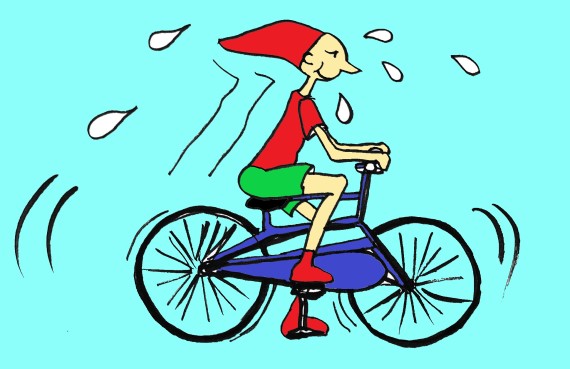
Pinocchio in bicicletta

Con un po' di sforzo in più, approfondisci l'argomento:

Presente dei verbi regolari

Il video

Adesso guarda questo breve video intitolato "mangiar sano". ("Mangiar" senza 'e' finale è una forma poetica e colloquiale di "mangiare").

Rispondi alla seguenta domanda:

Now watch this short video titled "mangiar sano" (to eat healthy). ("Mangiar" without the final 'e' is a poetic and colloquial form of "mangiare").

Reply to the following question:

  • Tu mangi sano?

Puoi sentire le seguenti parole?

"Mangiare sano è il modo più semplice per prenderti cura della tua salute e della tua bellezza. Però la vita è tua quindi fai quello che ti pare. Lo sai: non giocare con la vita".

Can you hear the following words?

"Mangiare sano è il modo più semplice per prenderti cura della tua salute e della tua bellezza. Però la vita è tua quindi fai quello che ti pare. Lo sai: non giocare con la vita." (Eating healthy is the easiest way to take care of your health and your beauty. But life is yours therefore do whatever you want. You know: Do not play with life).

This video is additional reference material and is not property of CyberItalian.
Should you have any problem viewing it, please notify us .
Thank you for your patience and collaboration!

Se non puoi vedere il video, ascolta qui l'audio:
If you can't watch the video, listen to the audio here:

Verbi irregolari: preferire, capire, piacere es. 2 es. 5 ed es. 6

Alcuni verbi italiani sono irregolari.

Ad esempio: in generale la radice è la parte invariabile del verbo, ma i verbi preferire e capire cambiano radice (aggiungono "SC").

Some Italian verbs are irregular.

For example: usually the root is the invariable part of a verb, but "preferire" (to prefer) and "capire" (to understand) change the root (they add "SC").

Osserva:

Infinito: Preferire
Presente Indicativo: io preferisco, tu preferisci... noi preferiamo, voi preferite...

Infinito: Capire
Presente Indicativo: io capisco, tu capisci... noi capiamo, voi capite...

Observe:

Infinitive: Preferire
Present Indicative: io preferisco, tu preferisci... noi preferiamo, voi preferite...

Infinitive: Capire
Present Indicative: io capisco, tu capisci... noi capiamo, voi capite...

Pinocchio in bicicletta

With a little extra effort, delve deeper into the topic:

Preferire capire finire

Il verbo "piacere" in italiano ha una costruzione particolare e la imparerai e praticherai maggiormente nelle lezioni future.

Per il momento, usa questa tecnica: quando ti piace qualcosa di singolare usa 'mi piace', quando ti piace qualcosa di plurale usa 'mi piacciono'.

The verb "piacere" in Italian has a special construction - you will learn it and practice more in the next lessons.

For the moment, just use this technique: when you like something singular use "mi piace", when you like something plural use "mi piacciono".

Osserva:

  • Mi piace la pizza! (I like pizza)
  • Mi piace mangiare. (I like to eat)
  • Mi piacciono gli spaghetti! (I like spaghetti)

Nota bene le espressioni "Ti piace? Ti piacciono?"

Notice the expressions "Ti piace? Ti piacciono?" (Do you like it? Do you like them?)

Osserva:

  • Ti piace la pizza? (Do you like pizza?)
  • Ti piace mangiare? (Do you like to eat?)
  • Ti piacciono gli spaghetti? (Do you like spaghetti?)

Per praticare il verbo Piacere completa le Attività.

To practice the verb Piacere complete the Activities.

Esprimere preferenze esercizio 6 esercizio 12

Alcune parole utili per esprimere preferenze sono:

- mi piace

- non mi piace

- preferisco

Some useful words to express preferences are:

  • mi piace = I like
  • non mi piace = I do not like
  • preferisco = I prefer

Frasi interrogative esercizio 6

In italiano non esiste una costruzione particolare per le frasi interrogative. È solo il tono della voce, leggermente ascendente verso la fine della frase, che rende una frase positiva o interrogativa.
In Italian there is not a special construction for interrogative sentences. The tone of your voice, with an ascending pattern toward the end of the sentence, makes it clear that you are asking a question.

In una frase l'accento cade sull'ultima parola e il tono della voce scende alla fine della frase (come in "Pinocchio è italiano").

In a sentence, the stress usually falls on the last word, and the pitch of the voice drops at the end of the sentence (as in "Pinocchio è italiano").

La domanda viene espressa con una intonazione in crescendo:
A question is expressed with a rising intonation:

Frasi negative esercizio 3

Per fare una frase negativa devi inserire "non" subito prima del verbo coniugato.

To make a negative sentence you must place the word "non" right before the conjugated verb.

IMPORTANTE
Pratica! Rendi viva la Grammatica e vai alla sezione Esercizi. Gioca con l'italiano e completa tutti gli esercizi disponibili.
IMPORTANT
Practice! Make the Grammar alive and go to the Exercise section. Play with the Italian language and complete all exercises provided.

Pronuncia

Ascolta la parola/frase, clicca sul microfono per registrarti e cerca di raggiungere il punteggio più alto!