❤️

Quando ci vediamo?

Here you will learn to make or postpone an appointment.

The linguistic elements you will find are:

ATTENZIONE: dalla lezione b_1 di questo Corso di Lingua Italiana abbiamo presentato tutti i commenti e le spiegazioni sia in italiano che in inglese. Durante il corso, cominciando da questa lezione (b_7), la lingua inglese verrà gradualmente ridotta o omessa. Il nostro obiettivo è quello di "rompere l'abitudine alla traduzione" e gradualmente presentare tutti i commenti e le spiegazioni in italiano, al fine di stimolare l'intuizione e l'abilità di comprensione dello studente.

Usa il dizionario online se trovi parole che non conosci o chiedi al Prof se hai problemi di comprensione.

PLEASE NOTE: starting from lesson b_1 of this Italian Language Course we have presented all comments and explanations in both Italian and English. During the course, starting with this lesson (b_7), the English language will be gradually reduced or omitted. Our goal is "to break the habit of translation" and gradually present all comments and explanations in Italian in order to stimulate the student's intuition and ability of understanding.

Use the online dictionary if you find words you don't know or ask the Prof if you have problems understanding.

Prendere un appuntamento. Le ore. esercizio 4 ed esercizio 5

Alcune parole utili per prendere o posporre un appuntamento sono:

  • a che ora?
  • ci incontriamo
  • ci telefoniamo
  • disdire un appuntamento
  • domani
  • dopodomani
  • insieme
  • oggi
  • posporre un appuntamento
  • prendere un appuntamento
  • telefonare
  • vengo
  • vieni

Some useful words for making or postponing an appointment are:

  • a che ora? = at what time?
  • ci incontriamo = we meet
  • ci telefoniamo = we call each other
  • disdire un appuntamento = cancel an appointment
  • domani = tomorrow
  • dopodomani = day after tomorrow
  • insieme = together
  • oggi = today
  • posporre un appuntamento = postpone an appointment
  • prendere un appuntamento = make an appointment
  • telefonare = to call, ring up
  • vengo = I come
  • vieni = you come

Per prendere un appuntamento è utile conoscere le ore e i giorni della settimana.

Nell'italiano parlato usiamo la congiunzione "e" per dire ore e minuti.

To make an appointment it is useful to know the hours and days of the week.

In spoken Italian we use the conjunction "e" (and) to say hours and minutes.

Le dieci. ore 10 Le dieci e mezzo. ore 10:30
Le dieci e un quarto
(o le dieci e quindici).
ore 10:15 Le dieci e quarantacinque.
Le dieci e tre quarti.
ore 10:45

Osserva:

- Che ore sono? - Che ora è?
- Sono le quattro. ore 4 - È l'una. ore 13
- Sono le dieci. ore 10
- Sono le dodici. soleore 12 - È mezzogiorno. soleore 12
- Sono le ventiquattro lunaore 12 - È mezzanotte. lunaore 12
L'italiano scritto separa le ore dai minuti con una virgola:
In writing, Italians separate hours from minutes with a comma:

sono le 10,30

Per gli orari ufficiali (orari pubblici, all'aeroporto o alla stazione...) il tempo è dato utilizzando le 24 ore del giorno:
Official time (in printed schedules, airports, railway stations...) is always given using the 24 hours of the day (military time):

sono le ventidue e trenta

Le dieci. ore 10   Le dieci di mattina. soleore 10
Le dieci e mezzo di sera. lunaore 10:30   Le ventidue e trenta
(orario ufficiale, in aeroporti o stazioni...
official time, airports, railway stations...)
lunaore 10:30

Le undici meno un quarto.
Le dieci e quarantacinque.
Le dieci e tre quarti.

Le ventidue e quarantacinque.

ore 10:45

Per definire un orario si usa "a" e "alle":

To define a time we use "a" and "alle" (at):

  • Che ore sono? (What time is it?) Le due. (Two o'clock.)
  • A che ora usciamo? (At what time do we go out?)
    Alle due. (At two.)

I giorni della settimana esercizio 6

I giorni feriali sono lunedì, martedì, mercoledì, giovedì e venerdì.

Sabato e domenica sono il fine settimana.

Weekdays are Monday, Tuesday, Wednesday, Thursday and Friday.

Saturday and Sunday are the weekend.

L'agenda o Diario

(Organizer/planner)
settimana feriali

Il fine settimana

(weekend)
Giorni festivi

Il diario di Pino
durante la settimana

lunedì

STUDIARE MATEMATICA E SCIENZE

PALESTRA

martedì

STUDIARE ITALIANO

LEZIONE DI CHITARRA

mercoledì

STUDIARE STORIA E GEOGRAFIA

PALESTRA

giovedì

STUDIARE FILOSOFIA

LEZIONE DI CHITARRA

venerdì

STUDIARE LATINO

PALESTRA

il fine settimana

sabato domenica

CON AMICI

SUONARE

CON AMICI

FARE I COMPITI

Durante la settimana, (il lunedì, martedì, mercoledì, giovedì e venerdì), lavoriamo.

Il fine settimana, (il sabato e la domenica), facciamo vacanza.
In Italia, la domenica è il giorno di vacanza ufficiale .
Molti italiani la domenica ascoltano la messa in chiesa e poi mangiano con amici e parenti. Altri passano la giornata fuori città, visitano posti vicini al mare, in campagna o in montagna. Altri riposano a casa durante il giorno e poi vedono gli amici la sera.

Osserva:

  • Sabato mangio al ristorante (il sabato che arriva - WITHOUT the article it means this coming Saturday)
  • Il sabato mangio al ristorante (ogni sabato - WITH the article it means every Saturday)
  • Di sabato mangio al ristorante (ogni sabato - every Saturday)
  • La sera mangio al ristorante (ogni sera - every evening)
  • La mattina non mangio (ogni mattina - every morning)
  • Il fine settimana mangio al ristorante (ogni fine settimana - every weekend)
  • Questo fine settimana mangio al ristorante (il fine settimana che arriva - this coming weekend)

I mesi dell'anno esercizio 2

I mesi dell'anno sono 12.

Le stagioni dell'anno sono 4 (primavera, estate, autunno, inverno).

The months of the year are 12.

The seasons of the year are 4 (primavera, estate, autunno, inverno = spring, summer, autumn, winter).

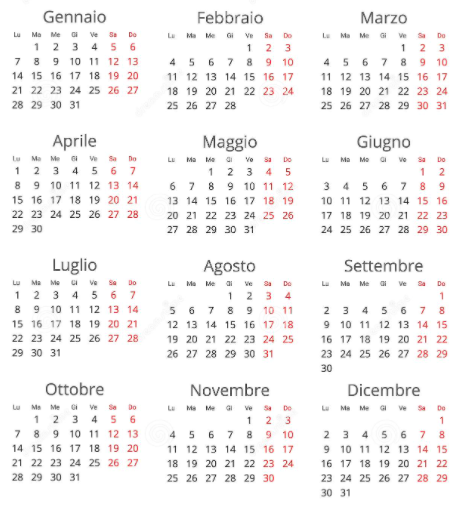
Il calendario

calendario

Il calendario di Pino

Gennaio

1 Gennaio: capodanno

Febbraio

4 febbraio: compleanno

Marzo

20 marzo:

PRIMAVERA

Aprile

VACANZE di Pasqua

Maggio

studiare e recuperare

Giugno

21 giugno:

ESTATE

finisce la scuola

VACANZE!

Luglio

VACANZE al mare!

Agosto

15 agosto: ferragosto, VACANZE!

Settembre

la scuola

ricomincia

22 settembre:

AUTUNNO

Ottobre

studiare

Novembre

studiare

Dicembre

21 dicembre:

INVERNO

25 dicembre:

natale

VACANZE!

Nota:

  • Il primo gennaio è Capodanno.
  • Il 4 febbraio è il compleanno di Pino.
  • Il 20 marzo inizia la primavera.
  • Il 21 giugno inizia l'estate.
  • Il 22 settembre inizia l'autunno.
  • Il 21 dicembre inizia l'inverno.
  • Il 25 dicembre è Natale.
L'autunno, l'inverno, la primavera e l'estate sono le quattro stagioni dell'anno.

Verbi irregolari: dovere, volere, potere esercizio 3 esercizio 7 ed esercizio 8

Nelle lezioni precedenti hai imparato i verbi regolari. In questa lezione imparerai alcuni verbi irregolari. In italiano ci sono molti verbi irregolari.
In the previous lessons you learned about regular verbs. In this lesson you will learn some irregular verbs. Italian language has many irregular verbs.

Rivediamo come funzionano i verbi italiani. Sono formati da due parti: la radice (invariabile) e la desinenza (variabile). Nei verbi regolari "ballare, ridere, dormire", "are", "ere" e "ire" sono desinenze e BALL-, RID- e DORM- sono radici.

Let's review how Italian verbs work. They consist of two parts: stem (invariable) and ending (variable). In the regular verbs "ballare, ridere, dormire", (to dance, to laugh, to sleep) "are", "ere" and "ire" are endings and BALL-, RID- and DORM- are stems.

Io ballO. Io ridO. Io dormO.

Tu ballI. Tu ridI. Tu dormI.

Lui/Lei ballA. Lui/Lei ridE. Lui/Lei dormE.

Pino ballA. Io non ballO. Tu ballI?

Io ballO. Io ridO. Io dormO. (I dance,I laugh, I sleep.)

Tu ballI. Tu ridI. Tu dormI. (you dance, you laugh, you sleep.)

Lui/Lei ballA. Lui/Lei ridE. Lui/Lei dormE. (he/she dances, he/she laughs, he/she sleeps.)

Lui ballA. Io non ballO. Tu ballI? (He dances, I do not dance. Do you dance?)

Nei verbi IRREgolari sia la radice che le desinenze possono cambiare. Ad esempio, in "volere, dovere, potere", "ere" è la desinenza dell'infinito e V-, D- e P- sono parte della radice a cui attaccheremo altre desinenze (che cambiano a seconda della persona che fa l'azione e del tempo del verbo).

In the IRREgular verbs both the stem and the endings can change. For example, in "volere, dovere, potere" (want, must, can), "ere" is the ending of the infinitive and V-, D- and P- are part of the stem to which we will attach other endings (which change according to the person doing the action and to the verb tense.)

Esempio:

  • Vuoi venire con me? (Do you want to come with me?)
  • Sì, voglio venire con te. (Yes, I want to come with you.)
  • Possiamo prendere un caffè. (We can have a coffee.)
  • Sì, posso uscire. (Yes, I can go out.)
  • Devi venire lunedì! (You must come on Monday!)
  • Dobbiamo comprare il giornale! (We must buy the newspaper!)
  • Puoi mangiare la pizza? (Can you eat pizza?)
  • Possiamo mangiare la pizza. (We can eat pizza.)

Osserva:

  • Infinito: dov ere (must, have to)
    Presente: io devo, tu devi ... noi dobbiamo ...
  • Infinito: volere (to want)
    Presente: io voglio, tu vuoi, lui vuole ...
  • Infinito: potere (can, may, to be able)
    Presente: io posso, tu puoi...
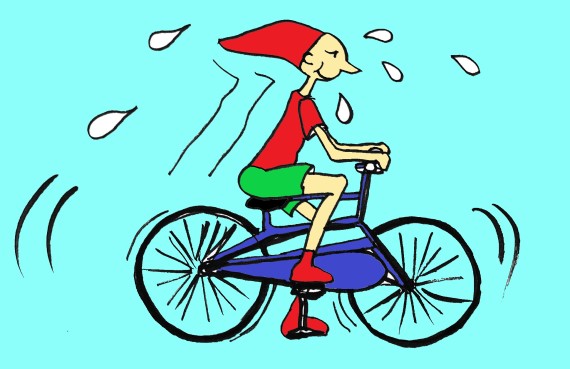
Pinocchio in bicicletta

With a little extra effort, delve deeper into the topic:

Dovere volere potere

Verbi irregolari: uscire, venire esercizio 3 esercizio 7 ed esercizio 8

Ecco altri verbi irregolari: uscire e venire.

Here are other irregular verbs: "uscire" (to go out) and "venire" (to come.)

Esempio:

  • Esci stasera? (Do you go out this evening?)
  • Sì, esco. (Yes, I go out.)
  • Vieni lunedì! (Come on Monday!)
  • No, usciamo mercoledì! (No, let's go out on Wednesday!)
  • Perfetto, vengo mercoledì. (Perfect, I come on Wednesday.)

Osserva:

  • Infinito: usc ire (to go out, to leave)
    Presente: io esco, tu esci ... noi usciamo ...
  • Infinito: venire (to come)
    Presente: io vengo, tu vieni...
Pinocchio in bicicletta

With a little extra effort, delve deeper into the topic:

Venire uscire
Non avere paura di studiare a memoria: è un ottimo esercizio per il cervello e per il cuore!
Don't be afraid of learning by heart: it is an excellent exercise for the brain and the heart!

Il tempo (atmosferico) esercizio 1 ed esercizio 9

In italiano usiamo spesso il verbo "fare" per indicare il tempo.

"Fa" (terza persona singolare del presente indicativo).

In Italian we often use the verb "fare" (to do, to make) to indicate the weather.

"Fa" (it does, it makes - third singular person of the present indicative).

CHE TEMPO FA?

OGGI FA BEL TEMPO

tempo bello

OGGI FA BRUTTO TEMPO

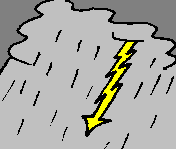
fulmini

OGGI PIOVE

pioggia

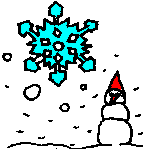
OGGI NEVICA

neve

OGGI C'È IL SOLE

tempo bello

OGGI È VENTOSO

vento

OGGI È NUVOLOSO

nuvola

OGGI FA CALDO

caldo

OGGI FA FREDDO

freddo

OGGI SI STA BENE!
NON FA NÉ CALDO,
NÉ FREDDO!

si sta bene

Pronuncia

Ascolta la parola/frase, clicca sul microfono per registrarti e cerca di raggiungere il punteggio più alto!