❤️

Bocconcino Grammaticale

Qui imparerai a scrivere una lettera, esortare e dare ordini.

Gli elementi linguistici che troverai sono:

Differenza fra italiano scritto e parlato esercizio 4

L'italiano, come tutte le lingue, contiene numerosi "linguaggi".
Ha un linguaggio colloquiale, "informale", e uno ufficiale, "formale", (pensate all'uso informale del "tu" e a quello formale del "Lei"); ha diversi tipi di gergo (pensate, ad esempio, a quello usato dai giovani, con espressioni idiomatiche particolari e, spesso, molte "parolacce"); ha numerosi dialetti (anche se i dialetti sono sempre meno parlati, soprattutto dai giovani, e stanno lentamente scomparendo); ha numerosi stili (lo stile burocratico, poetico, pubblicitario...) e numerosi linguaggi specialistici (il linguaggio politico, medico, giornalistico...)*

Italian, like all languages, is composed by different kinds of "languages", (slangs and styles). It has an "informal language" and a "formal language" (think about the use of the informal "tu" and the use of the formal "Lei"); it has different slangs (think about the slang spoken by young people, with specific idiomatic expressions and, often, many "bad words"); it has different dialects and is influenced by them (although dialects are less and less used, especially by young people, and are slowly disappearing); it has different styles (a burocratic style, a poetic style, an advertising style...) and several "specialized languages" (a political "language", a medical "language" a journalistic "language"...)*

Quando leggi o ascolti qualcosa in italiano, dunque, non dimenticare di considerare che tipo di linguaggio, stile, gergo o dialetto viene usato e di avere pazienza se non capisci qualcosa subito.
Therefore, when you read or listen to Italian, don't forget to evaluate what kind of "Italian language" you are reading or listening to and be patient if you don't understand something immediatly.
Esaminiamo ora le seguenti frasi:
Now, let's review the following sentences:
  1. Anche le relazioni con il re vanno bene..
    Relations with the king are also going fine.
  2. Le relazioni con il re procedono altrettanto bene.
    Relations with the king are proceeding just as well.

Noterai che la frase numero 1 è "più facile da capire" perché contiene parole più usate comunemente (anche, vanno). La frase numero 2 contiene parole meno usate comunemente (procedono, altrettanto), ma dice la stessa cosa della frase 1.

You will notice that sentence #1 is 'easier to understand' because it presents commonly used words (anche, vanno). Sentence #2 presents words that are commonly less used (procedono, altrettanto), but it says the same thing as sentence #1.

Considera queste altre frasi:
Now, look at these sentences:
  1. C'è stato un problema con il re d'Aragona.
    There has been a problem with the king of Aragon.
  2. Le scrivo per portare alla Sua attenzione un problema che si è verificato nelle relazioni con il re d'Aragona.
    I am writing to bring to your attention a problem that has occurred in relations with the king of Aragon.
In questo caso la frase 1 è addirittura semplicissima, mentre la frase 2 è più "complessa"; entrambe presentano lo stesso concetto.
In this case sentence #1 is 'simple', while sentence #2 is 'complex'; they both express the same concept.
Questa è molto genericamente la differenza fra l'italiano parlato e l'italiano scritto. L'italiano parlato usa spesso delle parole e espressioni usate comunemente. L'italiano scritto usa spesso parole e espressioni più "ricercate o formali".
In conclusion, we can say -very generically- that this is the difference between spoken and written Italian: the spoken language often presents commonly used words and expressions. The written language often presents words and expressions which are more sophisticated and formal.
* Il livello avanzato esplorerà più a fondo i diversi stili e linguaggi dell'italiano.
* The Advanced level will explore the different styles and idioms ​​of the Italian language with greater depth.

Formato lettera esercizio 2 esercizio 5 ed esercizio 7

Naturalmente, lo stile di una lettera varia molto a seconda della persona che scrive e della persona a cui la lettera è indirizzata. Se la lettera è per il capoufficio avrà un tono formale, se la lettera è per un amico avrà un tono colloquiale.
Obviously, the style of a letter changes accordingly to who writes the letter and to whom the letter is addressed. If a letter is for the head of the office it will be formal, if it is for a friend, it will be informal.

Una lettera formale deve essere scritta su carta intestata e avere il luogo e la data del giorno. Generalmente inizia con "Gentile Signora..." oppure "Egregio Signor..." e una virgola, e si conclude con "cordiali saluti" o "distinti saluti" e la firma. Il testo è breve e cortese.

A formal letter requires a letterhead, the place and date of the day. Generally, it starts with "Gentile Signora..." or "Egregio Signor..." and a comma, and ends with "cordiali saluti" or "distinti saluti" and the signature. The text is brief and corteous.

Una lettera ad un amico non ha bisogno di carta intestata; in genere vi si scrive la data del giorno, si inizia con "Caro..." o "Cara..." e una virgola, e si conclude con "ciao", "a presto", "un abbraccio" o "tanti saluti"... e la firma.

A letter for a friend does not require a letterhead; it usually have the date of the day, starts with "Caro..." or "Cara" and ends with "ciao", "a presto", "un abbraccio", "tanti saluti"... and the signature.

Nota la seguente espressione:
Please note the following expression:
  • Qua va tutto BENE. I miei accordi e le relazioni con il re procedono altrettanto BENE...
    Here everything is WELL. My negotiations and relations with the king are proceeding just as WELL...

La parola "bene", ripetuta due volte, denota una "mancanza di stile" che spesso si trova in lettere o messaggi informali (lo stesso avviene nella lingua parlata). Le ripetizioni sono generalmente poco eleganti, ma in una lettera formale ed educata diventano errori da evitare.

The word "bene", repeated two times, denotes a "lack of style", which often occurs in informal letters or messages (the same happens in the spoken language). Repetitions are generally inelegant, but in an official and polite letter they become mistakes to be avoided.

Ma nell'era di Internet, dei social e dell'email, chi scrive ancora lettere su carta agli amici?
But in the age of the Internet, social media and email, who is still writing paper letters to friends?

Osserva:

  1. Puoi leggere questa lettera per favore?
    Can you read this letter please?
  2. Leggi questa lettera!
    Read this letter!
  1. Mi scriverai una lettera?
    Will you write me a letter?
  2. Mandami due righe!
    Drop me a line!
  1. Signora, dovrebbe contattarmi appena possibile.
    My Lady, you should contact me as soon as possible.
  2. Signora, mi contatti appena possibile!
    My Lady, contact me as soon as possible!
  1. Tu non leggi mai.
    You never read.
  2. Non leggere più!
    Don't read any more!

"Leggi", "mandami", "mi contatti" e "non leggere", sono forme verbali dell'imperativo. L'imperativo (lo dice il nome) è usato per comandare, dare un ordine o un suggerimento, incoraggiamento, o esortazione.

"Leggi", "mandami", "mi contatti" and "non leggere" are verbal forms of the imperative. The imperative (as the name suggests) is used to give orders, to command, or to suggest.

Per formare l'imperativo si aggiungono le desinenze dell'imperativo alla radice dell'infinito (la prima persona, "io", non esiste).

Esempio:

  • Mandare = (tu) mand-a, (Lei) mand-i, (noi) mand-iamo...
  • Leggere = (tu) legg-i, (Lei) legg-a, (noi) legg-iamo...
  • Dormire = (tu) dorm-i, (Lei) dorm-a, (noi) dorm-iamo...

To form the imperative you replace the ending of the infinitive with the endings of the imperative (the first person "io" does not exist).

Example:

  • Mandare = (tu) mand-a, (Lei) mand-i, (noi) mand-iamo...
  • Leggere = (tu) legg-i, (Lei) legg-a, (noi) legg-iamo...
  • Dormire = (tu) dorm-i, (Lei) dorm-a, (noi) dorm-iamo...

Le particolarità sono queste:

  1. nella forma negativa, la seconda persona singolare (tu) utilizza "non" + l'infinito (non leggere!)
    Le altre persone (Lei, noi, voi, Loro) formano il negativo regolarmente (non legga, non leggiamo, non leggete...)
  2. La posizione del pronome, con l'imperativo di "tu, noi, voi" è alla fine del verbo (mandami due righe). Per "Lei, Loro" il pronome si mantiene di fronte al verbo (Signora, mi mandi due righe!)
  3. Alcuni verbi irregolari (dare, fare, stare e dire), nella seconda persona, raddoppiano la consonante del pronome a cui si uniscono "dammi" (dai a me), "dacci" (dai a noi), "fammi" (fai a me), "dimmi" (dici a me)...
  4. Nota l'espressione amichevole "stammi bene" (letteralmente "stai bene per me", prenditi cura di te).
  5. Alcuni verbi irregolari (andare, dare, fare, stare, dire), fanno cadere la "i" della seconda persona singolare: va', da', fa', sta', di' (ad esempio: "va' via" invece di "vai via". "Da' le chiavi a Roberto" invece di "dai le chiavi a Roberto".)

Please note:

  1. the negative form for the second person singular (tu) in formed with "non" + the infinitive (non leggere! = Do not read!)
    The other persons (Lei, noi, voi, Loro) have a regular negative form (non legga, non leggiamo, non leggete...)
  2. The position of the pronoun, with the imperative of "tu, noi, voi" is at the end of the verb (mandami due righe). Per "Lei, Loro" the pronoun remains in front of the verb (Signora, mi mandi due righe!)
  3. Some irregular verbs ("dare, fare, stare, dire"), in the second person, double the consonant of the combined pronoun "dammi" (give to me), "dacci" (give to us), "fammi" (make me), "dimmi" (tell me)...
  4. Note the friendly expression "stammi bene" (literally "be well for me", take care of yourself).
  5. Some irregular verbs ("andare, dare, fare, stare, dire"), drop the "i" of the second person singular: va', da', fa', sta', di' (for example: "va' via" = go away, instead of "vai via". "Da' le chiavi a Roberto" = give the keys to Bob, instead of "dai le chiavi a Roberto".)
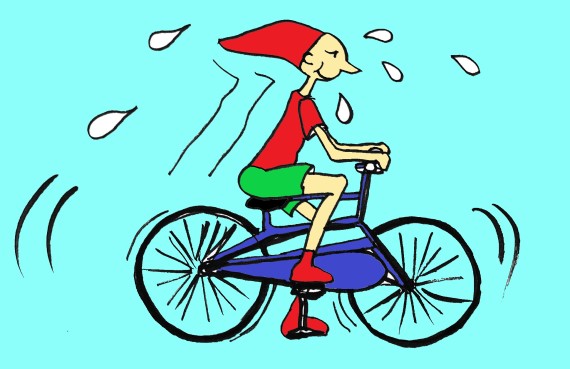
Pinocchio in bicicletta

Con un po' di sforzo in più, approfondisci l'argomento:

Imperativo

Molto bene! Ti ha spaventato la grammatica? Rilassati! Vogliamo solo darti gli elementi per capire i meccanismi della lingua.

Ricorda però che la pratica è l'unico segreto per imparare. Vaiavanti dunque e fai gli esercizi!

Pronuncia

Ascolta la parola/frase, clicca sul microfono per registrarti e cerca di raggiungere il punteggio più alto!