

 Qui trovi le soluzioni del "Bocconcino Culturale".
Ascolta l'audio mentre leggi il testo.
In Italia, "dare del Lei" è una forma di cortesia molto usata, diffusa sin dal Rinascimento. Ma perché si usa il Lei, il femminile, sia per donne che per uomini? Una domanda interessante. Alcuni fanno derivare questa forma dal concetto di "donna angelicata", tipico della poesia del XIII secolo, in cui la donna era considerata come un "angelo" o un "tramite verso Dio". L'elemento femminile era considerato ricco di potenzialità e ''venerabile''.
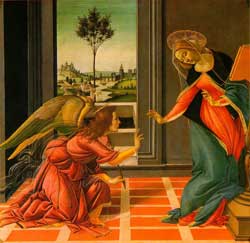
Nel seguente quadro vediamo come anche la figura di Maria, la Madonna, venisse dipinta con grandissima importanza. |
In Italy, "dare del Lei" is a widely used form of courtesy, widespread since the Renaissance. But why is Lei, the feminine, used for both women and men? An interesting question. Some assume this form derives from the concept of "angelic woman", typical of thirteenth-century poetry, in which the woman was considered as an "angel" or the "intermediary to God". The female element was considered full of potential and ''venerable''.
In the following picture we see how even the figure of Mary, the Madonna, was painted with great importance. |
|---|

In the office, we use the courtesy form "Lei"

With people we are not acquainted with, we use the courtesy form "Lei"

With teachers and professors, we use the courtesy form "Lei"
L'Annunciazione è un tema ricorrente nella pittura prerinascimentale e rinascimentale. Rappresenta un brano del Vangelo: il momento in cui Maria riceve dall'arcangelo Gabriele la notizia che darà alla luce il bambino Gesù, mandato da Dio. |
The Annunciation is a recurring theme in the pre-Renaissance and Renaissance painting. It represents a passage from the Gospel: the moment when Mary receives the news by the archangel Gabriel that she will give birth to a baby sent by God, Jesus. |
|---|
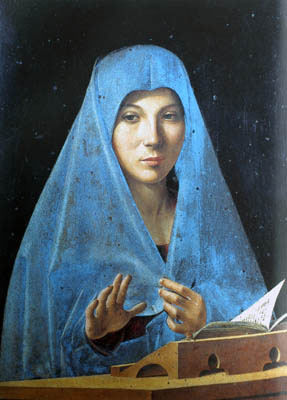
Nel quadro seguente non vediamo l'angelo, l'annunciazione, la storia o il paesaggio. C'è solo l'Annunciata, Maria, la donna, con la sua solitudine e la sua reazione alla notizia inaspettata.
La grande intuizione di Antonello da Messina, l'autore, è stata quella di focalizzare il suo dipinto sull'individuo: Maria.
Antonello ha fatto quasi un primo piano cinematografico. La donna sembra pensierosa. O forse guarda l'angelo inginocchiato davanti a lei. |
In the following picture we do not see the angel, the Annunciation, the story or the landscape. There is only the Announced, Mary, the woman, with her solitude and her reaction to unexpected news.
The great insight of Antonello da Messina, the author, was to focus his painting on the individual: Mary.
Antonello did almost a movie close-up. She looks thoughtful. Or maybe she is watching the angel kneeling in front of her. |
|---|


;)
;)
Beginner Lesson 19
Lesson Tools:
References:
Navigation: