Buona Pasqua! (Happy Easter!)

Il nuovo logo di CyberItalian. Perché amiamo la lingua e la cultura italiana, lavoriamo con passione e ti vogliamo bene!

Il nuovo logo di CyberItalian.
Perché amiamo la lingua e la cultura italiana,
lavoriamo con passione
e ti vogliamo bene!


La parola Pasqua vuol dire “passaggio” ed è simbolo di cambiamento e rinascita. Quest’anno noi di CyberItalian festeggiamo la Pasqua pubblicando il nostro nuovo logo e offrendoti uno sconto sui nostri corsi.
Approfitta del nostro sconto pasquale del 10% sui Corsi con Tutore e sulle Lezioni Private.
Attenzione: l’offerta termina il 5 aprile, 2018!

The word Easter means “passage” and it is a symbol of change and rebirth. This year at CyberItalian we celebrate Easter by publishing our new logo and offering you a discount on our courses.
Take advantage of our 10% Easter discount on the Tutored Courses and Private Lessons.
Act quickly as the offer ends April 5, 2018!

To practice Italian this week we invite you to listen and test…
PRACTICE HERE: Italian/English Version

Para practicar el idioma italiano esta semana te invitamos a escuchar y probar…
PRACTICA AQUÍ: Versión Italiano/Española
La donna angelicata e l’approccio formale (The formal approach)

La lingua italiana usa il pronome femminile “Lei” per esprimere un approccio formale, sia che si parli ad una donna sia che si parli ad un uomo.
Ma perché si usa la forma femminile? Una domanda interessante.
Cosa ne pensi tu? (INformale)
Cosa ne pensa Lei? (FORMALE)

In Italian we use the feminine pronoun ‘Lei’ (She) to express a formal approach, regardless of the fact that one may be talking to a woman or to a man.
Why do we use the feminine form? An interesting question indeed.
‘Cosa ne pensi tu?’ (What do you think about it? INformal)
‘Cosa ne pensa Lei?’ (What do you think about it? FORMAL)

To practice Italian this week we invite you to read and test…
PRACTICE HERE: Italian/English Version

Para practicar el idioma italiano esta semana te invitamos a leer y testar…
PRACTICA AQUÍ: Versión Italiano/Española

Tarantella: Cicerenella sei buona e bella (Tarantella: Cicerenella you are kind and beautiful)


La parola “tarantella” indica alcune danze tradizionali tipiche del sud Italia. Cicerenella è una famosa tarantella del XVIII secolo che è stata reinterpretata attraverso gli anni da grandissimi autori quali Roberto Murolo e Beppe Barra.
Ascolta di seguito alcune versioni del brano.
Quale versione preferisci?

The word “tarantella” indicates some traditional dances typical of southern Italy.
Cicerenella is a famous tarantella from the 18th century that has been reinterpreted through the years by great artists such as Roberto Murolo and Beppe Barra.
Listen below to some versions of the song.
Which version do you prefer?

To practice Italian this week we invite you to read and listen…
PRACTICE HERE: Italian/English Version

Para practicar el idioma italiano esta semana te invitamos a leer y escuchar…
PRACTICA AQUÍ: Versión Italiano/Española

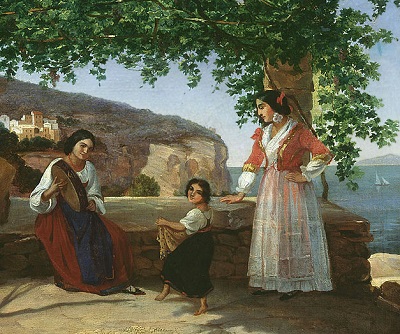
Image: Italian Women dancing Tarantella by Apollon Mokritsky 1846, source wikimedia commons

Devo riprendermi – verbi con pronomi (I must recover – verbs with pronouns)

Picture courtesy of Maura Garau

Boxer at rest. Unknown author, late 4th–2nd century B.C.
Museo Nazionale Romano, Rome.


A volte alcune situazioni della vita ci possono abbattere. Ci sentiamo giù. Ma dobbiamo riprenderci e risalire. A volte è faticoso ma “salire” è importante.
E tu?
Sali o scendi?

At times some situations in life can bring us down. We feel down. But we have to regroup and stand up again. Sometimes it is hard but “salire” (to rise, go up) is important.
And you?
Do you go up or down?

To practice Italian this week we invite you to sing and test…
PRACTICE HERE: Italian/English Version

Para practicar el idioma italiano esta semana te invitamos a cantar y testar…
PRACTICA AQUÍ: Versión Italiano/Española

Picture source: Maura Garau private collection

Anna Magnani e i pronomi combinati (combined pronouns)

In Italia la vecchiaia è ancora percepita come qualcosa di prezioso. La vecchiaia porta esperienza e porta una “bellezza particolare”. Ultimamente, la moda e la chirurgia estetica spingono molte persone a nascondere la propria età. Tuttavia, lo spirito italiano tende ancora ad avere grande rispetto per ciò che ha un passato, una storia ed una lunga esperienza di vita.
La famosissima attrice Anna Magnani, sul set intimava al suo truccatore: “Le rughe non coprirle che ci ho messo una vita a farmele venire!”
E a te piacciono le rughe?


In Italy old age is still perceived as something precious. Old age brings experience and a “particular beauty”. Lately, fashion and plastic surgery have been urging people to hide their age. However, the Italian spirit tends to have a great respect for everything that has a past, a history and a long experience of life.
The world-famous actress Anna Magnani used to say to her make-up artist: “Don’t cover my wrinkles, it took me a lifetime to get them!”
And you? Do you like wrinkles?

To practice Italian this week we invite you to watch and test…
PRACTICE HERE: Italian/English Version

Para practicar el idioma italiano esta semana te invitamos a mirar y testar…
PRACTICA AQUÍ: Versión Italiano/Española

Picture from the movie Mamma Roma

La Pincia della Befana (La Pincia of the Befana)

image source 123rf.comLa tradizione culinaria italiana presenta spesso dei piatti poveri e semplici ma molto gustosi.
In Veneto un’antica ricetta dell’Epifania (il 6 gennaio) è la Pincia.
Ti piace scoprire ricette antiche?

The Italian culinary tradition often has modest and simple but very tasty dishes.
In the Veneto region an ancient recipe for the Epiphany (on January 6) is Pincia.
Do you like to discover ancient recipes?

To practice Italian this week we invite you to read and cook…
PRACTICE HERE: Italian/English Version

Para practicar el idioma italiano esta semana te invitamos a leer y cocinar…
PRACTICA AQUÍ: Versión Italiano/Española
image source 123rf.com

Il dolce di Capodanno! (New Year’s Eve Dessert)

Picture source 123rf.com
Il grande medico Ippocrate diceva: “è preferibile un cibo un pò nocivo ma gradevole, a un cibo totalmente sano ma sgradevole.”
Sei d’accordo?
Per Capodanno, affinché il tuo nuovo anno sia dolce, prepara questo delizioso dessert: è molto buono e non fa male!

The great doctor Hippocrates used to say: “a good food that’s a bit harmful is preferable to a totally healthy but unpleasant food.”
Do you agree?
For New Year’s Eve, in order to have a sweet new year, prepare this delicious dessert: it’s very good and it is not bad for your health!

To practice Italian this week we invite you to read and cook… PRACTICE HERE: Italian/English Version

Para practicar el idioma italiano esta semana te invitamos a leer y cocinar… PRACTICA AQUÍ: Versión Italiano/Española
Buone Feste! (Happy Holidays!)

Image source 123rf.comA CyberItalian amiamo combinare tradizione e innovazione.
In qualsiasi modo tu festeggi, ti auguriamo delle splendide giornate con la tua famiglia e gli amici.
Buone Feste!

At CyberItalian we love combining tradition and innovation.
In any way you celebrate, we wish you wonderful days with your family and friends.
Happy Holidays!

Festività italiane – esercizio di ascolto (Italian festivities – listening exercise)

Image source https://commons.wikimedia.org/wiki/File:Reggio_calabria_processione_festa_madonna_2.jpgAgli italiani piace fare festa e vacanza ogni volta che è possibile. Oltre alle feste nazionali, ogni città festeggia il santo patrono (ad esempio a Roma si festeggiano San Pietro e Paolo il 29 giugno e in questo giorno a Roma, non nel resto dell’Italia, è vacanza).
Ogni volta che è possibile “si fa il ponte” cioé se la festività è durante la settimana si aggiungono uno o due giorni di vacanza fino al fine settimana.
Ti piace fare tante feste e vacanze?

Italians like to have holidays and vacations whenever possible. In addition to national festivities, every town celebrates its patron saint (for example Rome celebrates St. Peter and St. Paul on June 29 and this day in Rome, not in the rest of Italy, is an official holiday).
Whenever possible Italians “make the bridge” that is if the holiday is during the week, they add one or two days of holiday until the weekend.
Do you like to have many holidays and vacations?

To practice Italian this week we invite you to listen and test…
PRACTICE HERE: Italian/English Version

Para practicar el idioma italiano esta semana te invitamos a escuchar y testar…
PRACTICA AQUÍ: Versión Italiano/Española

Picture source: wikipedia.org

L’uomo che vive due volte (the man who lives twice)

“L’uomo che vive due volte” è un romanzo fanta-storico: la storia di un uomo che nasce nel 1870 (l’anno dell’unificazione finale dell’Italia con l’acquisizione di Roma) e delle sue avventure attraverso la storia italiana del XX secolo.
Nel romanzo, il protagonista ha un metabolismo rallentato e può godere di una lunghissima giovinezza.
Che ne dici? Ti piacerebbe vivere una vita lunga il doppio?
Vorresti vivere due vite?

“L’uomo che vive due volte” (the man who lives twice) is a “history-fiction” novel: the story of a man born in 1870 (the year of the final unification of Italy with the acquisition of Rome) and his adventures through the Italian history of the 20th century.
In the novel, the main character has a slow metabolism, so he enjoys a very long youth.
How about that? Would you like to live a double-length life?
Would you like to live two lives?

To practice Italian this week we invite you to test…
PRACTICE HERE: Italian/English Version

Para practicar el idioma italiano esta semana te invitamos a testar…
PRACTICA AQUÍ: Versión Italiano/Española