


| L'Uomo Vitruviano è un famoso disegno di Leonardo da Vinci (1490 circa), simbolo dell'arte rinascimentale. Questo intrigante capolavoro rappresenta le proporzioni ideali del corpo umano, basate sugli studi dell'architetto romano Vitruvio, e mostra una forte relazione fra la geometria e il corpo umano.
Ma perché questo disegno appare sulle monete da 1 euro italiane? |
The Vitruvian man is Leonardo da Vinci’s famous drawing from around 1490, and one of the icons of Renaissance art. This fascinating masterpiece captures the “perfect” proportions of the human body, inspired by the work of the Roman architect Vitruvius, and shows just how closely geometry and the human form are linked.
But why does this drawing show up on Italian one-euro coins? |
|---|
Why does the Vitruvian man by Leonardo da Vinci
appear on the Italian one-euro coins?
Share this activity:

"Uomo vitruviano" (Vitruvian Man) by Leonardo da Vinci
(c. 1490).
Pen, brown ink and watercolor over metalpoint on paper.
34.4 cm × 24.5 cm (13.5 in × 9.6 in)
Gallerie dell'Accademia, Venice
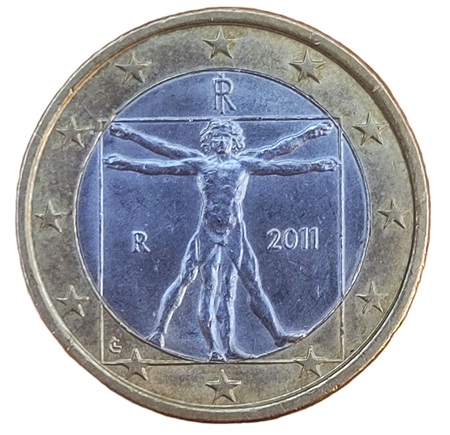
Gli spiccioli di euro sono uguali in tutta Europa ma ogni nazione ha un lato nazionale con qualcosa di tipico.
L'uomo vitruviano è l'immagine scelta dall'allora ministro delle Finanze (e più tardi Presidente della Repubblica Italiana) Carlo Azeglio Ciampi per apparire sulle monete da 1 euro italiane, a causa del suo alto valore simbolico di "uomo come misura di tutte le cose"). |
Euro coins look the same everywhere in Europe, but each country gets to put something special on its own side.
For Italy, the Vitruvian Man was chosen by Carlo Azeglio Ciampi - who was Finance Minister at the time and later became President of the Republic. He chose it because of its powerful symbolism: the idea of “man as the measure of all things.” |
|---|---|
Tuttavia, osservando attentamente si possono scoprire altri aspetti interessanti di questo disegno (Leonardo spesso includeva significati e messaggi nascosti all'interno dei suoi lavori).
Ad esempio, il quadrato significa "razionalità" mentre il cerchio rappresenta l' "emotività". L'uomo di Leonardo è molto equilibrato nell'essere entrambe le cose: razionale ed emozionale.
Nello stesso modo, il quadrato rappresenta la terra, e il cerchio rappresenta il cielo/universo. L'uomo di Leonardo è molto equilibrato nel suo essere con i piedi per terra (avere delle fondamenta solide) e nell'essere aperto all'Universo (mantenendo una grande visione, aspirando ad alti ideali e abbracciando quello che porta la vita).
Le braccia e le gambe dell'uomo di Leonardo puntano verso diverse direzioni. L'uomo di Leonardo è così "equilibrato e centrato" che può prendere molte direzioni diverse, vivere in piena libertà e fare sempre le scelte più appropriate per se stesso e per il mondo che lo circonda. |
However, if you look closely, you can discover other fascinating aspects of this drawing (Leonardo often included hidden meanings and messages in his works).
For example, the square stands for “rationality,” while the circle represents “emotion.” Leonardo’s man is perfectly balanced in being both: rational and emotional.
In the same way, the square symbolizes the Earth, while the circle represents the Sky and the Universe. Leonardo’s man is balanced here too - firmly grounded with solid foundations, yet open to the Universe, keeping a broad vision, aspiring to high ideals, and embracing whatever life brings.
The arms and legs of Leonardo’s man stretch out in different directions. This shows how centered and balanced he is: free to move in many directions, to live with complete freedom, and to always make the choices that are best for himself and for the world around him. |
Rifletti:
1. Sei una persona equilibrata? 2. Sei una persona razionale o emotiva? 3. Quanto dobbiamo essere equilibrati per maneggiare i soldi? 4. L'Economia e la finanza possono essere umane? |
Take a moment to think:
1. Are you a balanced person? 2. Are you more rational or more emotional? 3. How balanced do we need to be in order to manage money? 4. Can economics and finance be truly human? |
|---|